FILTERS
My main software packages are Adobe CC, Lightroom,Photomatix, Fisheyehemi DXO11, I also use Camranger for focus stacking and colormunki for monitor to printer calibration( I use an EIZO pair of monitors). The software give some digital alternatives to Filters in front of the lens, but there are certain things it cannot do. The main filters that seem indispensible to me are :-
For Black and White my Lee Resin 100mm x 100mm Yellow 8, Orange 21, Red 23A, and Red 25 are often in use. These are contrast control filters for B&W and increasingly absorb blue light and eventually some green too. An example of their use might be that they will darken a Blue sky whilst leaving the white fluffy clouds bright and white, so making the clouds stand out against the clear blue parts of the sky. However, they can also penetrate haze and mist, (why did French headlights and our foglights used to be Yellow?), and the extent to which this is happening can be seen through the viewfinder. I don't lug a laptop around with me, the rest of the kit is quite heavy enough! In anycase the software cannot"see" through mist and haze.
My Hoya U-360 For ultraviolet photography this lets UV light pass and blocks out visible light it also lets IR pass a bit so needs to be used in conjunction with my Schott BG39 which blocks the IR but allows the UV through.
Looking at the filters below the RM90(which pass IR above 900nm), the R72(which pass IR above 720nm) and the U-360 which passes UV below 360nm and a bit of IR between 710nm and 860nm appear opaque to the naked eye whilst the Schott BG39 appears turquoise.

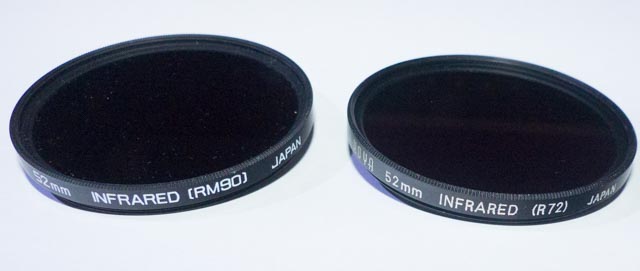
For some sample images using the filters mentioned so far.View the IR aand UV sections.
Polarisers are not reproducible in software. They will remove reflections from non-metallic surfaces eg seeing into water. They also can be used to darken the sky when shooting at right angles to the sun. The effect varies with angle to the sun and so their use with wide angle lenses is not so good as the sky ranges from pale blue though dark blue and back to light blue. Polarisers always have to be the front most filter when using more than one filter at a time eg with a neutral grad. The polariser has to be rotated to match the polarised light direction that you wish to stop (usually a reflection). They come in circular and plane polarisation - this is nothing to do with their shape but the way the light waves are oscillating (see here for more physics)Linear give a stronger effect but foul up auto focus and metering functions in many through the lens systems.

Neutral density filters come in various amounts of absorbtion. and can be no, soft or hard graduated (to be continued)

colour modifying filters

Fogs
